Monday, 14 September 2009
Hampstead and Highgate Literary Festival
I'm doing an event tonight, It's at 6.15, so if you find yourself anywhere near Hampstead, please come

Saturday, 12 September 2009
Parties, gardens, libraries, red toe nails, and other delights


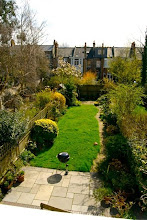
It's a beautiful day in September, and summer doesn't seem quite gone (the picture above was taken in Scotland last month, where I was writing the Henry James-goes-to-Tillypronie blog). As it happens, my toe nails were red in that picture, and they're red again today; well, they've been red all week, in honour of the London Library. Yes, I know that sounds unlikely -- the London Library is the most literary of places, where nail varnish should never be discussed; but it turned up, along with me, at a party there a couple of days ago; because I've just contributed an essay about the joys of red toenails to Modern Delight, an anthology of essays published by Faber and Waterstones, in aid of the London Library and Dyslexia Action. The book was inspired by J.B Priestley's original collection of essays, 'Delight', published in 1949; the author, a self-confessed 'grumbler', wrote about the little things in life that made him happy: a gin-and-tonic, detective stories in bed, smoking in a hot bath, meeting a friend, charades, the sound of a football, buying books, having his fortune told, coming home... I'm sure you'll be able to come up with your own lists. (Please do, and tell me about them -- we all need to be reminded of small delights on a daily basis, don't you think?)
Anyway, Priestley's book has been reprinted in a 60th anniversary edition, and is delightful; and the new anthology has lots of good things in it, too: Beryl Bainbridge on growing older; India Knight on twitter; Sebastian Faulks on a certain girl band... and many, many more.
Anyway, this is my contribution, along with some pictures of the London Library (including a room full of good cheer); it's a place that brings me great delight, as does the garden in Tillypronie.
Oh, and by the way, the red nail varnish I refer to in the following piece is by Essie (and no, I didn't know the name until after I chose the colour).
If you believe what you read in fairytales, then wearing red is perilous, presaging doom and disaster. Would Little Red Riding Hood have encountered the wolf if she wore a more modest blue? And could Briar Rose have avoided her long imprisonment as Sleeping Beauty, if she had not stained herself with her own blood after pricking her finger? Worst of all is the dreadful fate summoned up by Hans Christian Andersen for a little girl named Karen after she acquires a new pair of immodest red shoes, for she is cursed to dance until her feet are bleeding, and then her feet are chopped off. As it happens, Andersen’s father was a shoemaker who died when Hans was 11, which is perhaps a clue as to why soles are inextricably linked with souls in his stories (hence the sufferings of the Little Mermaid, who wishes for feet in her pursuit of love, but discovers that they bring her nothing but pain.)
Yet despite these dire warnings of childhood reading, in fairytales where no one lives happily ever after, I have grown up to discover the cheering effects of shoes the colour of rubies, and the delight to be had in painting my toe nails red. Indeed, when disaster strikes – as it does from time to time, when men turn into wolves, and love is gobbled up – then the small pleasures of cherry-red varnish loom large in my life.
One cannot wear red shoes on a daily basis – that would detract from their potency; from the magic they bring to an evening of bold celebration – but scarlet toenails are a secret that can be enjoyed throughout the year. On the coldest nights in winter, they peek out of the scented bubbles of a warm bath; and in the darkest nights of the soul, they point to a way forward, a glowing reminder that the future may not be quite as gloomy as feared.
As I write this on a rainy morning in an English spring, my crimson toenails are hidden in sheepskin slippers, but I know that when the sun emerges, so will my feet. By the way, the varnish comes out of a small bottle marked Well Red… an antidote to the grimmest of fairytales
Wednesday, 9 September 2009
Later that night...
It's 9.9.09. Luckily, I am not entirely deranged, as I have not been seized by a sudden belief in numerology (thereby madness lies), but I do like the pleasing pattern in today's date... All of which may or may not have something to do with the fact that I have been writing about Chanel no. 5, and the significance (or otherwise) that Coco Chanel attached to numbers...
Now, I'm going to take a deep breath, and count to ten, and then return to Coco...
Now, I'm going to take a deep breath, and count to ten, and then return to Coco...
Tuesday, 8 September 2009
Late night, grappling with computer

It's hot in my study, at the end of a long day at the screen. I'm beginning to feel unhinged, after writing and writing and writing and...
So, here in the spirit of openness, is me deranged as midnight comes nearer. (Incidentally, the clock on my blog is wrong, but I don't know how to change it. One of these days, it might strike 13). Now I'm going to drink a strong cup of camomile tea. Never let it be said that I don't know what's good for me...
Sunday, 6 September 2009
Bibliotherapy: what to read when in need of cheering up
 This week's bibliotherapy: v. good for convalescence, as well as Sundays:
From time to time, on a Sunday evening, I feel a certain glumness descend, a gloomy foreboding about Monday morning, and all the responsibilities it entails. As tonight is a very Sunday-ish evening – the end of summer, the return to routine – a little light reading is in order. Most cheering of all in the circumstances is P.G. Wodehouse’s ‘Psmith in the City’, first published in 1910, but still consoling for anyone who would rather be somewhere else tomorrow.
Wodehouse himself understood the predicament of his central character, Mike Jackson, who yearns to be playing cricket at Cambridge University, but has been sent to London to earn his living as a clerk for the New Asiatic Bank, due to a collapse in the family finances. The young Wodehouse was dispatched in similar circumstances to the Hong Kong and Shanghai Bank in the City, where he endured an equally monotonous start to his career, before making his escape as a writer. In this early novel, Wodehouse introduced an instant antidote to boredom, in the form of Rupert Psmith, an expelled Old Etonian incarcerated in the City, but with the wit to find his way out. Psmith (the ‘P’ is silent, ‘as in phthisis, psychic, and ptarmigan’) is an advocate of what he describes as ‘practical socialism’, making comrades of his colleagues, and undermining their odious boss, Mr Bickersdyke, thereby coming close to scuppering Bickersdyke’s political ambitions.
‘Psmith in the City’ is very funny, very subversive, and not at all what one might expect from a writer accused of being a Nazi sympathiser after his broadcasts from Berlin during the Second World War. In hindsight, the general consensus seems to be that Wodehouse was foolish, rather than fascist (George Orwell rejected the claim that Wodehouse had ‘consciously aided the Nazi propaganda machine’ as ‘untenable and even ridiculous’). Yet despite his political naivety, Wodehouse’s vision of the City as oppressive and incomprehensible – ‘the whole system of banking was a horrid mystery’ – now seems refreshingly honest. Unfortunately, we don’t all have Psmith as a comrade against the challenges of boredom or confusion, nor as an ally against the Bickersdyke-type. But Wodehouse remains reassuring; for as Mike discovers at the close of play, ‘He examined the future, and found it good’.
Friday, 4 September 2009
Full moon at midnight
The full moon is high in the sky above my back garden, and a fox has just trotted along the pavement. I wish I could find the words to describe the moonlight tonight -- it's so clear, bright enough for the trees to cast shadows across the grass. But there is a cloud inside my head (the after-effect of a general anaesthetic), and my tongue is getting tangled, like my fingers on the keyboard.
Still, I'm glad to be here, in the moonlight, rather than behind the double-glazed windows of a hospital room. Now, back to bed...
Still, I'm glad to be here, in the moonlight, rather than behind the double-glazed windows of a hospital room. Now, back to bed...
Thursday, 27 August 2009
Of gardens and frog's bones and gingerbread cake...


Thanks to Cornflower, I've got some new bedside reading, 'The Cookery Book of Lady Clark of Tillypronie'; and can therefore understand why Henry James and others were so enthusiastic about their hospitable hosts in Scotland. Lady Clark's recipes were published as a book in 1909, after her death, providing a comprehensive range that cater from the most conservative tastes (Balmoral Dessert Biscuits, often served at Tillypronie, from a recipe supplied by H.M. the Queen's Baker, at nearby Bamoral Castle), to the more arcane ('Ritualistic Haddock', 'Wet Devil', 'Boiled Angels', and 'Frog's Bones', which turn out to be crisp vanilla biscuits).
I don't think Frog's Bones will be served with the teas on Sunday afternoon at the Tillypronie garden opening, but there will be cake, so here is one of Lady Clark's three recipes for Gingerbread Cake.
1lb. treacle, 12 ozs. butter; put these into the oven to melt, and add to 1 lb. flour, 1/2 lb. moist sugar. Mix altogether with a little ginger and lemon peel; spread it then upon the tin to bake, and loosen it from the tin whilst still warm, or it will stick.
Cornflower may elucidate further on quantities, as I know she is very good at baking, but I think that for 'moist sugar', one might substitute soft dark brown sugar, and I like zesty gingery cakes, so I'd add more than a little ginger.
The other recipe that caught my eye -- well, actually, there were lots that did, but here is one of many -- is for Oeufs a la Bechamel, and it is labelled as Mesdames Langel's and Justine's Recipe, 1879. According to Lady Clark's husband, Sir John Clark, in a letter written from Tillypronie in 1901 to the future editor of his wife's book, she gathered a considerable knowledge of French and Italian cookery while he was serving in the Diplomatic Service in Paris, Brussels and Turin: 'she never failed, when any dish interested her, to cross-examine the artist the next day, who, perceiving the intelligent appreciation she evinced in his art, rarely failed to give her the best of his knowledge and experience.'
Presumably this explains the wealth of detail in the following recipe for Oeufs a la Bechamel:
Boil 6 eggs hard in boiling water, but not so hard as when cooked for canarybirds' food. To simmer only 10 minutes. When cold, peel off the shells, cut the eggs in two, lengthways, leave the yolks in and place the half-eggs, with the yolks uppermost, in an enamel dish capable of going into the oven, and put a tiny bit of fresh butter on the centre of the yolk of each half-egg. Pour the following sauce over all, and just colour in the oven, but not long enough to harden the whites.
For the Sauce: Rub 2 ozs. of fresh butter with flour and put into a saucepan. Stir well till it is smooth, taking care it does not burn. Add cream, or even milk, and stir on on till it is the proper thickness. Add salt, pepper, and a grate of nutmeg. Cook this thoroughly before pouring it over the eggs, then give them a minute in the oven, and brown with a salamander to a gold colour.
Yum yum.
And now back to Chanel, who I doubt ate much in the way of cake, even when she was in Scotland.
Subscribe to:
Posts (Atom)